

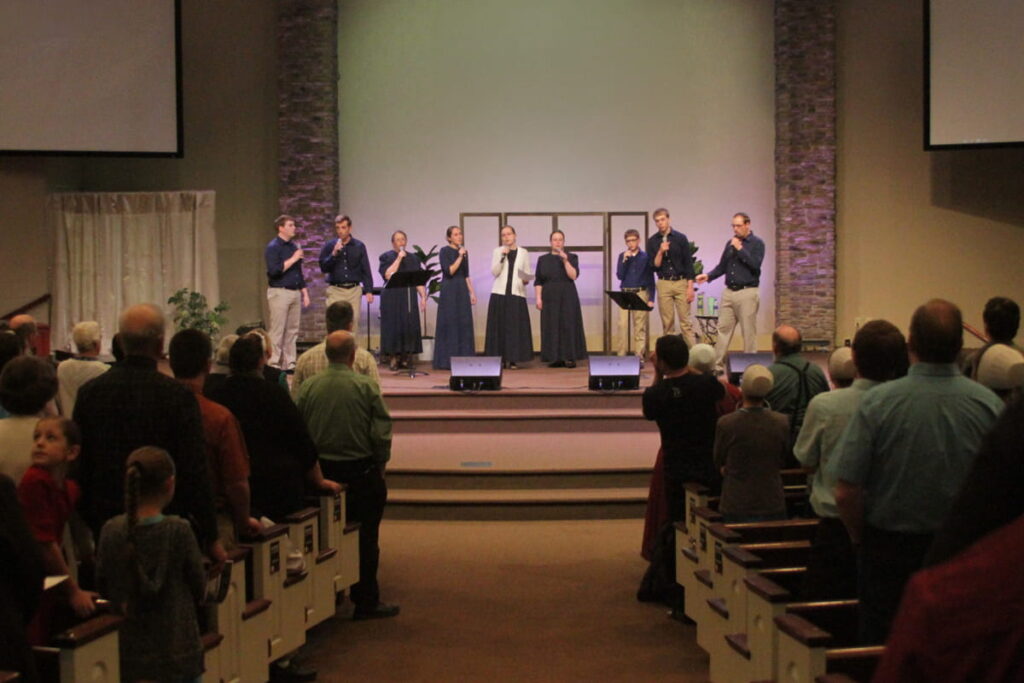
Our purpose here is to explore the reasons why we sing and to understand the role singing plays in our worship experiences. Colossians 3:16 says: “Let the word of Christ dwell in you richly as you teach and admonish one another with all wisdom, and as you sing psalms, hymns and spiritual songs with gratitude in your hearts to God.” Numerous other scriptures, notably in the Old Testament, tell us we should “sing unto the Lord.” Psalm 95 is perhaps most notable: “O come, let us sing unto the LORD: let us make a joyful noise to the rock of our salvation. Let us come before his presence with thanksgiving, and make a joyful noise unto him with psalms. For the LORD is a great God, and a great King above all gods. In his hand are the deep places of the earth: the strength of the hills is his also. The sea is his, and he made it: and his hands formed the dry land. O come, let us worship and bow down: let us kneel before the LORD our maker. For he is our God; and we are the people of his pasture, and the sheep of his hand.” In these verses (1–7a) of Psalm 95, we are admonished to sing to the Lord, to praise and thank Him for His greatness, acknowledge His sovereignty, and prostrate ourselves before Him in worship and adoration. He is the object of our worship in song.
But why do we sing? The late black Gospel singer Mahalia Jackson, in her inimitable rendition of “His Eye Is On the Sparrow,” expressed herself this way: “I sing because I’m happy, I sing because I’m free!” We sing when we’re happy. We also sing when we realize we’re free—free from the constraints of sin.
In fact, the entire range of human emotions finds expression in song. For example: Happiness — “Oh, how happy are they who their Saviour obey, and have laid up their treasures above! Oh, what tongue can express the sweet comfort and peace of a soul in its earliest love.” Love — “Love divine, all love excelling, Joy of heaven to earth come down, fix in us Thy humble dwelling, all Thy faithful mercies crown.” Joy — “Joy to the world! the Lord is come! Let earth receive her King: let every heart prepare Him room, and heaven and nature sing.” Contentment — “One sweetly solemn thought comes to me o’er and o’er, nearer my home today am I than e’er I’ve been before.” Sorrow — “Jesus, while our hearts are bleeding o’er the spoils that death has won, we would, at this solemn meeting, calmly say, ‘Thy will be done.’” Comfort — “A Friend I have, called Jesus, whose love is strong and true, and never fails how-e’er ’tis tried, no matter what I do; I’ve sinned against this love of His, but when I knelt to pray, confessing all my guilt to Him, the sin-clouds rolled away. It’s just like Jesus to roll the clouds away, it’s just like Jesus to keep me day by day, it’s just like Jesus all along the way, it’s just like His great love.”
We also sing to admonish one another. “Christian, walk carefully, danger is near; on in thy journey with trembling and fear. Snares from without and temptations within seek to entice thee once more into sin. Christian walk carefully, Christian walk carefully, Christian walk carefully, danger is near.”
We sing to express gratitude to God. Moses and Israel sang a song of praise to God for delivering them from the Egyptians, as recorded in Exodus 15. We sing: “We bless Thy name, O Lord, Thy goodness we record, we tell Thy great and wondrous love, we publish it abroad.”
We sing to challenge or encourage one another. “Would men know you’ve been with Jesus, can they feel His presence near? As with them you joy and labor, as with them you journey here? Can men tell that you love Jesus, can they by your life and mine see in daily walk and action that we have His life divine?” A challenge to faithfulness.
We sing to bring conviction by way of evangelistic invitation. We sing: “Jesus the Crucified Pleads for Me,” “Just As I Am,” “Come to the Savior Now,” “Softly and Tenderly,” “Almost Persuaded,” “Why Not Tonight?,” “Where Will You Spend Eternity?”—songs intended to stir the soul to respond to the call of God for salvation.
We sing to seal commitment. “More love to Thee, O Christ, more love to Thee! Hear Thou the prayer I make on bended knee; this is my earnest plea, more love, O Christ, to Thee, more love to Thee, more love to Thee.”
When do we sing? We sing at church, as an aid or adjunct to worship. We begin our services with song in order to get everyone involved and participating in the service from the start. This has a binding, cohesive effect on the worshippers. The type of songs we sing sets the mood for worship—praise, adoration, supplication, confession. Special song services provide opportunity to unite our voices in an outpouring of praise for an extended time and give opportunity to express numerous facets of praise, adoration, commitment, etc.
We sing for evangelistic appeal. An evangelist of bygone years once said: “More souls have been sung into the kingdom than have been preached in.” Singing appeals to the emotions in a way the spoken word does not.
We sing when we’re alone, as we go about our work, as we drive, etc. Singing can be done most anywhere and by anyone—even those who may think they cannot sing. God is more impressed by sincerity than by excellence.
Singing in special groups is also beneficial. Singing in a small group fosters dependence on one another. Each individual must do his part to produce harmony. It creates a sense of interdependence and unity through the expression of praise and worship.
How do we sing? With the voice God gave us. Perhaps the most important aspect of singing is that we sing with a keen awareness of the object of our praise. We should also sing with interest and enthusiasm, paying close attention to the message of the songs as well as to the music. And of course, we cannot sing without opening our mouth. So let’s open our mouths and sing! “I will sing unto the LORD as long as I live: I will sing praise to my God while I have my being.” (Psalm 104:33)