

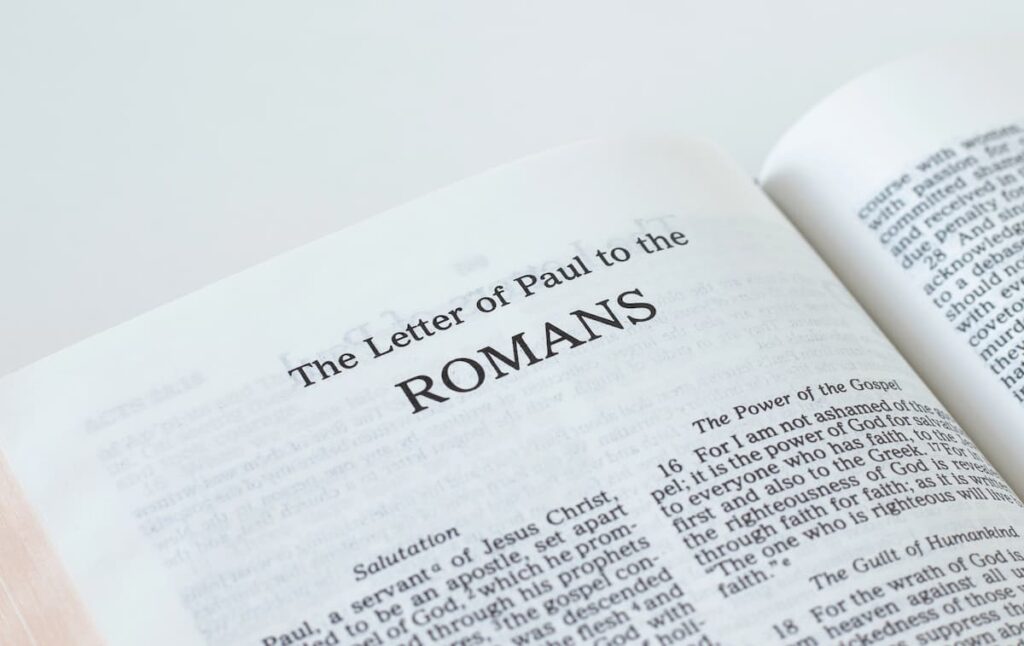
Most people throughout human history have been concerned with how to please God – or in most cultures throughout history – their god or gods. The Old Testament tells of how God made provisions from the time of creation for people to have a right standing with Him. Since the Reformation, the teaching of most Protestant churches has been justification by faith alone. But often the question arises: is there a discrepancy between what Paul and James say regarding justification? We must not forget that the same author, the Holy Spirit, inspired both books as the men penned the words. Therefore, though some groups downplay either Paul’s or James’ use of faith, all Scripture teaching on faith must be read as complementary: Paul focuses on God declaring sinners righteous by their faith apart from works of the law while James explains that this same faith will demonstrate itself through works.
Being justified is to have a right standing with a Holy God, to be seen as righteous in His eyes. Our faith is counted (or imputed) to us for righteousness. We use terms such as being saved, redeemed, born again, etc. These different terms may refer to different aspects of our salvation, but without being justified, we are not in good standing with God. And if we are not in good standing with God and seen as righteous, we are lost.
Faith in Romans
Romans makes it clear that we are justified by faith alone. Paul uses Abraham as an example in Romans 4:3 to show that his faith was counted to him for righteousness. Genesis 15:4-6 says: “And, behold, the word of the LORD came unto him, saying, This shall not be thine heir; but he that shall come forth out of thine own bowels shall be thine heir. And he brought him forth abroad, and said, Look now toward heaven, and tell the stars, if thou be able to number them: and he said unto him, So shall thy seed be. And he believed in the LORD; and he counted it to him for righteousness.” Romans 3:28 says: “Therefore we conclude that a man is justified by faith without the deeds of the law.” Notice in this verse it specifically states the deeds, or works, of the Mosaic Law. That means that we cannot be saved by any works, no matter how good they may be. But we must differentiate between works of the law and the works that follow justification – the works that flow out of a justified and sanctified heart.
This faith is described in clear terms in Romans 4:18-25: “Who against hope believed in hope, that he might become the father of many nations, according to that which was spoken, So shall thy seed be. And being not weak in faith, he considered not his own body now dead, when he was about an hundred years old, neither yet the deadness of Sara’s womb: He staggered not at the promise of God through unbelief; but was strong in faith, giving glory to God; 21 And being fully persuaded that, what he had promised, he was able also to perform. And therefore it was imputed to him for righteousness. Now it was not written for his sake alone, that it was imputed to him; But for us also, to whom it shall be imputed, if we believe on him that raised up Jesus our Lord from the dead; Who was delivered for our offences, and was raised again for our justification” (Emphasis mine). We can clearly see that if we believe on Jesus, His physical resurrection and atoning blood, we are justified in Christ. Romans 5:9 says “Much more then, being now justified by his blood, we shall be saved from wrath through him.”
Faith in James
James has something to say about Abraham and justification. This discourse begins in 2:14 “What doth it profit, my brethren, though a man say he hath faith, and have not works? Can faith save him?” He continues through chapter 2 to show how Abraham was justified by works and not faith only. The scripture calls faith without works a “dead faith.”
So how do we reconcile the supposed differences regarding justification, faith, and works in Romans and James? There are several aspects to consider that bring clarity. First is the context.
Book Context
Romans spends the first three chapters showing how everyone, Jew and Gentile, is a sinner. What is the answer to this? What is the way for all of humanity to be reconciled to God? It is faith in God and the provision He made for reconciliation. Are we fully persuaded that what God has promised, He is also able to perform? God has promised to save us to the uttermost (Hebrews 7:25 “Wherefore he is able also to save them to the uttermost that come unto God by him, seeing he ever liveth to make intercession for them.”) Romans moves from showing how all have sinned and come short of God’s glory to showing how to be saved. Then it moves on to what being justified looks like, living free of bondage and living in the Spirit, and much exhortation on practical Christian living. The book is laid out in a systematic format.
James is more of a book regarding practical Christian living and what it looks like to be a follower of Jesus Christ. So instead of contradicting Romans, it actually complements it. The book of James is not a treatise on soteriology. James describes how saving faith looks and how it is lived out on a daily basis, both personally and with regard to our relationships. It is not just empty words or claims of belief but a true faith that changes the heart. So, context is key to understanding what Romans and James say about justification.
Word Meaning
We must also consider what the words used mean in each context. Words such as justification have certain theological definitions that have been forged over the years. This does not mean the meanings have changed from the original uses, but keep in mind that the early writers and church leaders were not bound by our strong theological definitions. This is true of how justification was used in different contexts. Although the basic meaning is the same in both books, let’s consider how justification was used in another scripture. Jesus said that “wisdom is justified of her children” (Matt 11:19; Luke 7:35). Jesus was not saying that wisdom has a right standing with God. But wisdom is proven, or vindicated, by its fruit. The Williams translation uses such language in Matthew 11:19 “…wisdom is vindicated by her doings.” Abraham’s faith was vindicated, or proven, by the faith and obedience that followed. If Abraham would have done the same works without faith in God, it would not have vindicated his faith. But according to James, his faith worked with his obedience and his faith was made perfect or complete.
God is the judge of our faith and works. In Matthew 25, there were those who didn’t realize they had done good things for Jesus and those who were sure they had done those things. But God knew their works and motives. He also was quite aware of His true children and those who were not. This moves us to the next area to consider.
Dead Faith
James says that faith without works is dead. He gives practical examples and historical examples. Can faith alone save someone? It is by grace, through faith, that we are saved. But true faith always brings about obedience to God. We may not always obey immediately. It may take some ongoing work of the Holy Spirit in our lives. But if we really do believe that God is able to perform the promises He has made, it will produce a desire to please God. So, James can rightly say that faith without works is dead. He is not saying the works of the law, but godliness played out in the life of the believer. Godliness includes, or perhaps is manifested, in doing good. This includes obedience, obeying Christ’s commands, and earnestly desiring to follow Jesus. Ephesians 2:8-10 says: “For it is by His unmerited favor through faith that you have been saved; it is not by anything that you have done, it is the gift of God. It is not the result of what anyone can do, so that no one can boast of it. For He has made us what we are, because He has created us through our union with Christ Jesus for doing good deeds which He beforehand planned for us to do” (Williams Translation). This passage lays it out clearly: salvation is by grace, through faith, with the works following.
James or Paul Only-ism
Groups who gravitate towards a works-based salvation promote James, while groups that tend to steer far away from even mentioning works look to Romans and Galatians for verification. It cannot be one or the other. We must take both into account. Salvation is by grace through faith. Our faith is vindicated by what we do with that faith. Some say we are saved by faith and kept saved by works. This is not true either. The scripture does not teach this. It teaches that true faith – saving faith – is evident in a believer’s life and obedience to God. God knows our motives for doing good, for obeying Him, and for living right. He knows if we have true faith.
When eternal rewards and punishments are mentioned in the New Testament, it mentions our works. It may say deeds done in the flesh, or their works do follow them. Again, this is not saying that our works are what saves us. But our faith is shown so clearly to God that He can judge our works, and the motives for them, because they flow out of either true faith or dead faith.
Conclusion
While some groups downplay either Paul’s or James’ use of faith, all Scripture teaching on faith must be read as complementary: Paul focuses on God declaring sinners righteous by their faith apart from works of the law while James explains that this same faith will demonstrate itself through works. Therefore it is imperative that we have a true saving faith in Jesus which brings about justification, sanctification, and a Spirit-filled life. Repentance and obedience will follow the one who is truly justified in Christ Jesus.