

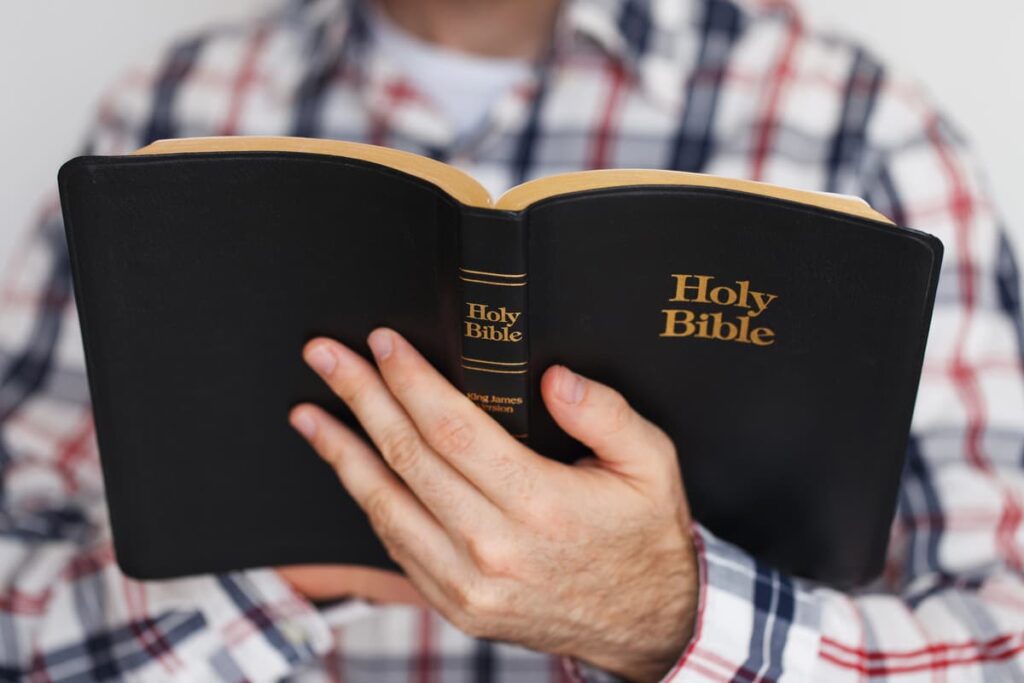
God wants Christians to follow Him. He transcends cultural and language barriers, even taking on human form. This means He desires to be heard and obeyed. Because God primarily communicates with His people through His translated words, it is imperative that people have Scripture intertwined with their common language in order to understand and submit to His authority. This article will contend that the King James Version, though an acceptable translation for its time, should be replaced as a primary translation because of shifts in language, manuscript evidence, and God’s desire for His Word to be in the vernacular.
I will first note how the KJV translators aimed to make a good translation better. Secondly, I will point out that the Elizabethan language of the KJV, which was slightly archaic in 1611, now contains many “dead words” and “false friends.” Thirdly, since the few manuscripts used as the basis of the KJV were limited and late, believers today should prefer the earlier and vast amounts of manuscripts/fragments used by contemporary translators. Finally, based on the nature of the incarnation, the biblical authors’ example, and the Great Commission, I will contend that God desires for His words to be in the common, vulgar tongue.
King James Version
When King James VI of Scotland became King James I of England in 1603, he took on a kingdom with many fractured religious groups. To start reconciling the differences, King James I called for a conference at Hampton Court (1604) with both Anglican bishops and Puritan clergy. At the conference, John Rainolds proposed a “new, more accurate Bible translation [which] won the King’s heart, despite the bishops’ grumbling.”[^1] This would allow King James to position himself as the leader of the united church. The King commissioned companies of scholarly men from different theological backgrounds to work on the “new translation.” It has been noted that it would be hard to unite fifty scholars today with the language range and depth of “other disciplines that characterized the KJV translators.”[^2] These men knew multiple languages, and as a group they consulted Spanish, Italian, Hebrew, Aramaic, Syriac, Greek, German, Latin, and even Douai translations.[^3]
These notable scholars were commanded to follow the 1602 Bishops’ Bible and alter it as little “as the truth of the original will permit.” They were also commanded to use Tyndale, Matthew, Coverdale, Whitchurch, or the Geneva Bible “when they agree better with the text than the Bishops’ Bible.”[^4] This is why the translators of the 1611 KJV say in the preface:
“We never thought from the beginning, that we should need to make a new Translation, nor yet to make of a bad one a good one, … but to make a good one better, or out of many good ones, one principal good one, not justly to be excepted against; that hath been our endeavor, that our mark. To that purpose there were many chosen, that were greater in other men’s eyes than in their own, and that sought the truth rather than their own praise.”[^5]
Therefore, the KJV subsequently revised earlier English translations rather than producing a brand-new translation. This accounts for why Tyndale’s idioms and vocabulary make up over 80% of the KJV’s word choices.[^6] The KJV translators accepted other translations because they recognized their work simply revised other translations.
Language Shift
Words change. Sometimes they simply go out of use. Over the past four hundred years, this shift has happened to the KJV’s English. In fact, James White noted that many pages could be filled with “unclear, difficult readings based upon archaic language from the KJV.”[^7] Surprisingly, some of this archaic language existed from the start. The translators used mildly archaizing language by design for the express purpose of “dignity and decorum” and for “familiar or felicitous phrasings.”[^8] This so-called conservatism elevated a “craggily reverent, distinctively scriptural style” that cemented this holy-sounding language into people’s religious talk, even if it was stiff and unnatural in everyday language.[^9]
KJV readers today will read many dead words. These unused words should only cause a slight problem since readers know they must look them up. For example, what modern reader knows the original meaning of the following list that Dr. Edwin Palmer compiled?
“chambering” (Rom. 13:13), “champaign” (Deut. 11:30), “charger” (Matt. 14:8—it is not a horse), “churl” (Isa. 32:7), “cieled” (Hag. 1:4), “circumspect” (Exod. 23:13), “clouted upon their feet” (Josh. 9:5), “cockatrice” (Isa. 11:8), “collops” (Job 15:27), “confection” (Exod. 30:35—it has nothing to do with sugar), “cotes” (2 Chron. 32:28), “covert” (2 Kings 16:18), “hoised” (Acts 27:40), “wimples” (Isa. 3:22), “stomacher” (Isa. 3:24), “wot” (Rom. 11:2), “wist” (Acts 12:9), “withs” (Judg. 16:7), “wont” (Dan. 3:19), “suretiship” (Prov. 11:15), “sackbut” (Dan. 3:5), “the scall” (Lev. 13:30), “scrabbled” (1 Sam. 21:13), “roller” (Ezek. 30:21—i.e., a splint), “muffler” (Isa. 3:19), “froward” (1 Peter 2:18), “brigadine” (Jer. 46:4), “amerce” (Deut. 22:19), “blains” (Exod. 9:9), “crookbackt” (Lev. 21:20), “descry” (Judg. 1:23), “fanners” (Jer. 51:2), “felloes” (1 Kings 7:33), “glede” (Deut. 14:13), “glistering” (Luke 9:29), “habergeon” (Job 41:26), “implead” (Acts 19:38), “neesing” (Job 41:18), “nitre” (Prov. 25:20), “tabret” (Gen. 31:27), “wen” (Lev. 22:22)?[^10]
People who think the KJV should be the primary or only Bible must wrestle with the question of why they should hand people a Bible with so many dead words. Doesn’t God want the Bible in people’s normal, everyday language?
Unlike dead words, “false friends” are words that have changed meanings in ways the reader is unlikely to recognize. This means that many KJV words and phrases are used differently than 17th century England usage. For example, Mark Ward examines six main examples in his book that are worth considering: “halt” (1Kings 18:21), “God commendeth His love” (Rom 5:8), “so shall He sprinkle many nations” (Isa 52:14-15), “filthiness is not convenient” (Eph 5:3-4), “pause before you start serving others” (Rom 12:6-7), and “remove not the ancient landmark” (Prov 22:28).[^11] Mark, who appreciates the Authorized Version, still recognizes that modern readers literally cannot know that some words have changed meaning. He notes how people can learn to look up unfamiliar words, but comments that people do not know what they do not know.[^12] More examples of “false friends” can be found in these footnoted references.[^13]
Manuscript Evidence
The KJV used the Textus Receptus for its New Testament. Three men are responsible for creating this text: Desiderius Erasmus, Robert Estienne (Stephanus), and Theodore Beza. Erasmus created the original text and based it on merely “seven Greek manuscripts copied in the eleventh, twelfth, and fifteenth centuries,” and none of them had the full New Testament.[^14] Furthermore, the textual basis comes from a few late and “haphazardly collected minuscule manuscripts” which also render a dozen passages with no support from any known Greek witnesses. Despite Estienne and Beza adding later edits, all their manuscripts substantially agree. However, Beza occasionally added conjectural edits while editing the text that had no manuscript evidence. A few of these conjectural edits made it into the KJV.[^15]
Some people, including those in the KJV-only camp, object to modern scholars sorting through all the manuscripts and reconstructing what they believe the original manuscripts contained. However, their text rests on the work of Erasmus, who labored with the same basic methods used by modern scholars.[^16] Despite Erasmus’ elite scholarship and the Textus Receptus being good for its time, it is inferior today with the emergence of many more manuscripts and fragments that date centuries earlier, with the Dead Sea Scrolls pushing back the Old Testament significantly further. Not only were the manuscripts late, but unfortunately the Old Testament textual basis for the KJV was also poor. Consider the textual analysis as explained by Jack P. Lewis:
Of the five primary uncial manuscripts now received as authority for the purity of the text of the New Testament, only Codex Bezae was then available, and there is no evidence that it was used. Papyrus discoveries came three hundred years later. The King James scholars could have known fewer than twenty-five late manuscripts of the New Testament, and these were carelessly used. Today there are 5,358 known New Testament manuscripts and fragments.… The 1611 situation for the Old Testament was even poorer. The Complutensian Polyglot (1517) and the Antwerp Polyglot (1572) would have been the sources from which they would have known the Old Testament. Where these two differ, the KJV agrees with one or the other except in about a half-dozen places where it agrees with neither.[^17]
Today, Bible-believing scholars have access to thousands more manuscripts, and many of them are significantly closer to the time of the original authors. The textual scholar Peter J. Williams notes, “we now have nearly a thousand times more manuscripts than were used by Erasmus in his first edition, and as the gap between the earliest discovered manuscripts and the original writings has narrowed by nearly a thousand years, not much has changed.”[^18] For those who still use the KJV, this is good news because not much has changed, and the textual differences do not affect any major doctrine.
God’s Desire for a Vernacular Bible
[^19]
Examples from Manuscripts
During the third or second century BC, the Greeks commissioned seventy-two Jewish scholars to translate the Hebrew Bible into Greek. The New Testament authors normally quote or allude to this text rather than the Hebrew original. Interestingly, the Septuagint departs from the Hebrew passages in some cases. However, in God’s providence, it was used as “a vehicle of truth for evangelizing a Hellenized world, bearing an authority derived from the Hebrew Scripture insofar as it accurately reflects it.”[^20] Therefore, since the Holy Spirit allowed the biblical authors to feel comfortable quoting imperfect translations, Christians today can produce current idiomatic translations that carry God’s authority insofar as they accurately reflect the meaning of the original manuscripts.
The New Testament writers understood this principle when they translated Jesus’s words from Aramaic into the common (Koine) Greek language. Believers should understand that they wrote in the common Greek (Koine) instead of the formal/scholarly Greek (Classical/Attic). People commonly used Koine Greek to carry out normal tasks like writing wills, marriage contracts, private letters, shopping lists, and so on.[^21] Contrary to the “Holy Ghost language” that some have argued in the past, it was the plain, simple language of the people. Since God decided to use the “standard, contemporary, normal, common, vernacular Greek for the New Testament when he had other options,” should His followers not follow in His footsteps and “choose to do the equivalent in English?”[^22]
Transferring God’s message into a language and culture that people can understand is necessary and challenging. However, though translations are imperfect and flawed, God still accomplishes His purpose through translations. Yahweh did not force everyone to learn Hebrew, Greek, and Aramaic to avoid flaws in translations. Instead, He revealed Himself as the living Word and spoke in normal language. This fact alone should convince believers to translate or read Scripture in modern language.[^23]
Examples from the Incarnation
God taking on flesh was not glorious or perfect by human standards. The relational God of the universe taking the necessary steps to redeem humanity by becoming a human should be a little startling. This God, who communed with Adam and Eve, called Abraham, raised up Moses, and sent His Son, has always demolished barriers in order to communicate with humanity. An application that C. S. Lewis draws from the incarnation is that God “should be preached in a vulgar, prosaic and unliterary language. If you can stomach the one, you can stomach the other.”[^24] The incarnation allows believers to see that God can be worshipped through the normal, common means of communicating. This is why believers need to transcend the current cultural and language gaps through new or updated translations. Jesus, who took on flesh, transcended the Creator-creature gap and became identifiable (not foreign) to people. By allowing the Bible to be in the common language, Christianity can be seen as part of the current culture and not necessarily a foreign or antique religion. A current, vernacular translation allows people to envision Jesus walking in their shoes, wearing their clothes, and resembling them; this also enables them to imitate Jesus better.
Fulfilling the Great Commission
A vernacular Bible empowers local believers to better carry out Jesus’s command to make disciples (Matt 28:19). By allowing Scripture to be accessible, both parties of a discussion, Bible study, or an evangelistic conversation can better understand how God’s Word speaks to the subject at hand. The Great Commission also commands believers to disciple others to obey all that God commands. As William Tyndale noted, God works through the Bible to loosen sin’s bondage and empower believers to understand God’s commands and bear fruit. They must thereby understand Scripture in order to not be bound by the product of their own imagination.[^25] Therefore, Christians must freely access God’s commands in order not to violate God’s commands and thereby stunt their sanctification.
Conclusion
In this article, I have contended that the King James Version, though an acceptable translation for its time, should be replaced as a primary translation because of shifts in language, manuscript evidence, and God’s desire for His Word to be in the vernacular. Even the 1611 KJV translators recognized this by observing, “But how shall men meditate in that, which they cannot understand? How shall they understand that which is kept close in an unknown tongue?”[^26] Why should believers read, meditate, and memorize “dead words” and passages with “false friends”? God desires His Word to be in common speech, and “utilizing terms no longer a part of our language has no place in making the Scriptures available to all people.”[^27] Since Bible translators, including John Wyclif, William Tyndale, and Martin Luther, understood that allowing people to know God and follow Him meant translating His Word into their vernacular regardless the personal cost, why should we not follow in their footsteps and adopt a good modern translation as our primary translation?
Bibliography
Goodman, Lenn. “The King James Bible at 401.” Society 50, no. 1 (2013): 73-80. http://dx.doi.org/10.1007/s12115-012-9620-2.
Kruger, Michael J. A Biblical-Theological Introduction to the New Testament: The Gospel Realized. Wheaton, IL: Crossway, 2016. Logos.
Lewis, C. S. God in the Dock: Essays on Theology and Ethics. Edited by Walter Hooper. USA, Wm. B. Eerdmans., 2014.
Mounce, William D. Greek for the Rest of Us: The Essentials of Biblical Greek. 2nd edition. Grand Rapids: Zondervan, 2013.
Naudé, Jacobus A. “Emergence of the Tyndale–King James Version Tradition in English Bible Translation.” Hervormde Teologiese Studies 78, no. 1 (2022): 1–9. https://doi-org.ezproxy.sbts.edu/10.4102/hts.v78i1.7649.
Ross, William A. and Gregory R. Lanier. The Septuagint: What It Is and Why It Matters. Wheaton, IL: Crossway, 2021. Logos.
Teems, David. Tyndale: The Man Who Gave God an English Voice. Nashville. Thomas Nelson, 2012.
“The First Translation of the Bible among Indigenous Islamic Peoples Using a Mediating Approach.” The Southern Baptist Theological Seminary. Last modified May 2023. https://repository.sbts.edu/bitstream/handle/10392/7100/NameWithheld_sbts_0207D_10777.pdf?sequence=1&isAllowed
“The Translators to the Reader.” Authorized Version. Oxford, 1833. https://www.bible-researcher.com/kjvpref.html
Ward, Mark. Authorized: The Use & Misuse of the King James Bible. Editors: Elliot Ritzema, Lynnea Fraser, and Danielle Thevenaz. Bellingham, WA: Lexham Press, 2018. Logos.
Wegner, Paul D. The Journey from Texts to Translations: The Origin and Development of the Bible. Grand Rapids, MI: Baker Academic, 2004. Logos.
White, James R. The King James Only Controversy: Can You Trust Modern Translations? Minneapolis, MN: Bethany House, 2009. Logos.
Williams, Peter J. Can We Trust the Gospels? Wheaton, IL: Crossway, 2018.