
In an essay entitled Drawn Eastward: The Attraction of Eastern Orthodoxy for Western Christians, James R. Payton, Jr. writes, “Since the 1980s, interest in Eastern Orthodoxy has mushroomed in the West.”[^1] One prominent example of that interest is Franky Schaeffer, who joined the Greek Orthodox Church in 1990. Franky (the son of the popular author Francis Schaeffer) has been referred to as “an apostle for Eastern Orthodoxy.”[^2] Another example is the church historian and voluminous writer Jaroslav Pelikan, a Lutheran pastor who joined the Orthodox Church in 1998, when he was 74 years old.[^3] In 2006, after referring to Pelikan as an example of the pull exerted by Orthodoxy, Bradley Nassif mused, “It makes me wonder if the 21st century will be the century of the Orthodox.”[^4]
While exact numbers are difficult to calculate, there are likely approximately 2 to 3 million Orthodox believers in the United States. There may be up to 300 million Orthodox worldwide.[^5] The Apostles’ Creed includes an expression of belief in the “one, holy, catholic, and apostolic church.” Orthodox believers maintain that their church is that church. There are about fifteen different churches that fall within the bounds of Eastern Orthodoxy. Of those fifteen, the Russian Orthodox Church and the Greek Orthodox Church are probably the best-known.[^6] In this article, six important aspects of Eastern Orthodox theology will be described. Each description will be followed by a brief evaluation from a biblical perspective.
Scripture and Tradition
A hallmark of the Protestant Reformation in the sixteenth century was the emphasis on sola Scriptura (a Latin phrase that means “Scripture alone”). To put it simply, that concept is “the idea that Scripture alone is authoritative for Christian doctrine, not Scripture plus church tradition.”[^7] H. Wayne House writes, “According to the Orthodox faith, the doctrine of sola Scriptura is a dangerous teaching because the truth of Scripture cannot be alienated from the traditions of the church that gave rise to them.”[^8] While the Eastern Orthodox Church does believe that the Bible is God’s inspired Word, its commitment to interpreting Scripture through the lens of church tradition has led it to be called “the church of the seven councils.” As Orthodox theologian Timothy Ware has stated, the Bible “must not be regarded as something set up over the Church, but as something that lives and is understood within the Church.”[^9]
The seven councils that were just mentioned are referred to as “ecumenical” because their importance is acknowledged by both the Eastern Orthodox and Western Christians (such as Roman Catholics and Protestants). Those councils and years of assembly are “Nicaea (325), Constantinople (381), Ephesus (431), Chalcedon (451), Second Constantinople (553), Third Constantinople (680-81), and Second Nicaea (787).”[^10]
In response to the claim of some Orthodox theologians that the ecumenical councils made infallible theological pronouncements, it could be pointed out that those councils came to some conclusions that are unsupported by Scripture. Two such examples will be discussed later in this article: the perpetual virginity of Mary and the veneration of icons.[^11] In Mark 7:13, Jesus accused the Pharisees of “…making void the word of God by your tradition that you have handed down…” (ESV). While the legacy of church tradition is tremendously helpful, it must never be given a place of supreme authority.[^12] J.C. Ryle put it well: “Evangelical Religion does not despise learning, research, or the wisdom of days gone by…But while we do not despise learning, we steadily refuse to place any uninspired writings on a level with revelation.”[^13]
Infant Baptism
From the Eastern Orthodox perspective, “baptism itself is a saving sacrament. For Eastern Orthodox churches, baptism begins the process of salvation and growth toward participation in the divine nature.”[^14] Adult baptism is practiced in cases where people join the church later in life, but infant baptism is also thought to be necessary because even infants have been impacted by original sin and need to be cleansed. A connection is made between the Old Covenant practice of circumcision and the New Covenant practice of baptism. “If circumcision was performed in the Old Testament on all males, adult and infant…so much the more, according to the grace of the new covenant, the Sacrament of Baptism should be administered to infants.”[^15]
To support that claim, Orthodox theologians argue that salvation is a mystery. As such, it cannot be fully understood by humans, and neither can it be earned by humans. Since salvation does not depend in any way on human merit, infants should be baptized. Appeals are also made to household baptisms in the early church (Acts 16:15; 18:8) and to Jesus’ willingness for children to come to him (Matthew 19:13-15). Baptism is thought to be a gift of God’s grace that should not be withheld from children. For baptismal candidates who are unable to profess their faith in Jesus, parents or sponsors make that profession on their behalf. The parents and sponsors also commit themselves to teaching the child about the Christian faith.[^16]
A believer’s baptism response to this issue is rooted in the conviction that the only proper candidates for baptism are those who have made their own profession of faith. In Acts 2:38, Peter clearly connects repentance and baptism. There are no biblical commands to baptize those who have not personally repented. To contend for infant baptism from the household baptisms in Acts is flawed because that is an argument from deafening silence. It is only morally responsible and accountable individuals who can count the cost of following Jesus and freely submit to him as both Lord and Savior. These reasons are likely why infant baptism was not practiced until the third century of Christian history.[^17]
Mary
The teaching of the Orthodox Church on Mary presents her as the second Eve who gave birth to the second Adam. Eve was a virgin whose disobedience had deadly consequences for mankind; the new Eve was a virgin whose obedience was vital in providing salvation to mankind. The Most Holy Theotokos (God-bearer) is honored for her perpetual virginity; that is, she preserved her virginity forever. While Matthew 1:24-25 does not claim that Mary remained a virgin after the birth of Jesus, she is nevertheless the “Ever Virgin” to the Orthodox. That term can be traced to the Second Council of Constantinople in 553 (the fifth ecumenical council). In this view, the siblings of Jesus that are mentioned in Scripture (e.g., Mark 6:3) must be either his cousins or children from Joseph’s first marriage.[^18] The eighth-century theologian John of Damascus said of Mary that “the holy, incomparable virgin … so longed for virginity that she was transformed into it, as if consumed by the purest fire. Every virgin, after all, loses her virginity in giving birth; but she, who was a virgin before giving birth, remained so during her labors and even after them.”[^19]
In Orthodox theology, the sinlessness of the holy virgin Mary is also promoted: “The idea that the Most Holy Theotokos could partake in any kind of sin is deeply foreign to Eastern patristic tradition.”[^20] Mary’s so-called “immaculate conception” means that the effects of Adam’s sin were not passed on to her at the time she herself was conceived. That purification then extended throughout her life.[^21] What the Eastern Orthodox call the “Dormition” is “the belief that either before or after her death, the Virgin Mary was assumed bodily into heaven. After entering heaven, Mary…was crowned by Christ as the ‘Queen of Heaven.’ In this role, she makes intercession for sinners.”[^22] Many Protestants have argued that these ideas about Mary do not have a biblical basis. These viewpoints are certainly not affirmed in the New Testament, and it could be argued that they are not even implied. For example, historically speaking, belief in the assumption of Mary emerged in the sixth century.[^23] If that belief is biblical, why was it not affirmed at an earlier stage of church history?
Icons
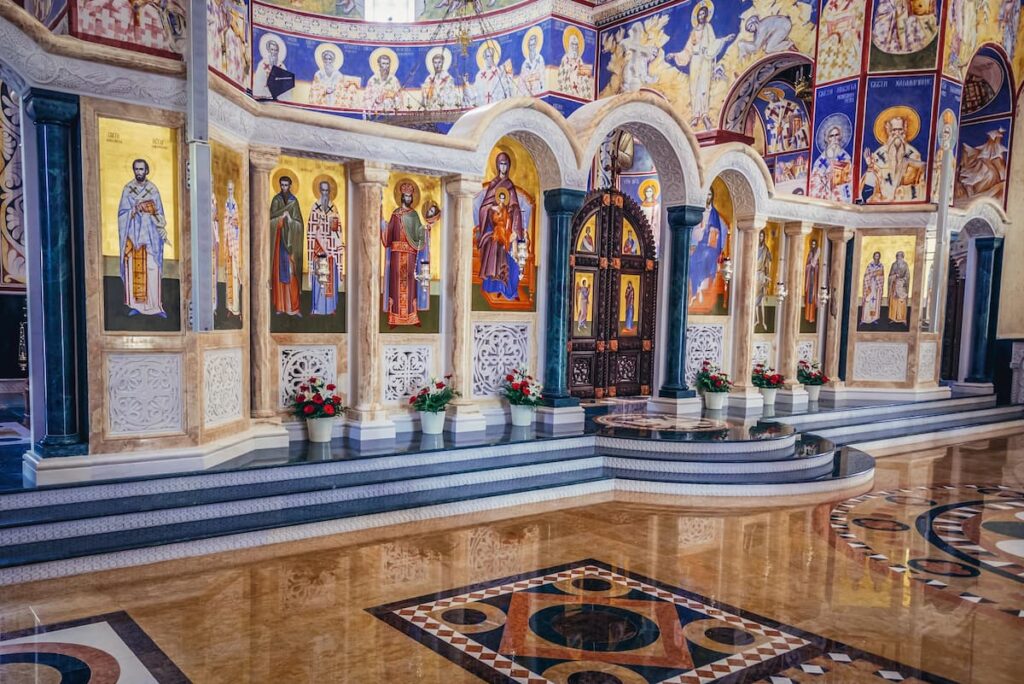
According to the church historian Bruce L. Shelley, to make sense of Eastern Orthodoxy, it is essential to understand their holy images, which are also called icons.[^24] Icons are something of a key to the entire Orthodox theological system. They are not religious statues; rather, icons are two-dimensional images that depict Jesus, biblical figures, and individuals from history that the Orthodox would identify as saints. Icons serve to remind believers “that the worship of the congregation on earth is a joining and sharing in the worship of the glorified Church in heaven; the icons are a window into that heavenly worship, revealing the presence of the saints and angels.”[^25] The saints and angels are important because “It is in company with them, and with the help of their prayers, that believers on earth approach and worship the Trinity.”[^26] Being “manifestations of the heavenly ideal,” icons “are a kind of window between the earthly and the celestial worlds.”[^27] The significance of icons in Orthodox is rooted in the biblical teaching that man is created in the image of God. That means that man “carries the icon of God within himself.”[^28] The implications of that for the Orthodox understanding of salvation will be discussed in the following section of this article.
The Orthodox writer James Guirguis explains that he asks Mary and the saints to intercede for him. He denies that the Orthodox pray to the saints or worship the saints. As he explains, “Asking the saints to intercede for us is simply talking to the saints as to friends and asking them to pray for us.”[^29] He appeals to Matthew 22:32, where Jesus said that “God is not the God of the dead, but of the living.” Guirguis argues that since the souls of the saints live on after their physical deaths, it is appropriate to converse with them.[^30] The evangelical writer Harold O.J. Brown acknowledges that the Orthodox, in their theology, are very careful to explain that they reverence or honor icons; they do not worship them. That is an important qualification. However, it is also quite possible that, in their practice, Orthodox believers do not always maintain that vital distinction.[^31] If icons are worshipped, that would be a clear violation of the biblical command to worship the Lord alone (Exodus 20:3). Furthermore, even if icons are not idolatrous, is there a solid biblical basis for the Orthodox insistence that icons be used in worship?[^32] In other words, just because something is permissible does not mean it is necessary.
Deification
Building off of the previous section, the Eastern Orthodox view of salvation is rooted in mankind’s status as God’s image-bearers. Historically, Western Christians (both Roman Catholics and Protestants) have understood salvation in a legal sense. From the Western perspective, sin ruptures the relationship that should exist between God and man; it alters man’s legal status before God. However, from an Eastern perspective, sin mars the divine likeness in man. The sinner “inflicts a wound in the original image of God.”[^33] In that understanding, salvation is the restoration or perfection of God’s image in man. The Greek term theosis (deification, or “becoming gods”) is sometimes misunderstood, so it should be clarified that “Orthodox teachers do not claim that believers become Father, Son, or Spirit, but use the language to picture the transformation of believers to become fit companions for an eternal communion with and in the triune God.”[^34] The fourth-century theologian Athanasius is often quoted on this point: “God made himself man that man might become God.”[^35] Or, in the words of another theologian from the same century, Gregory of Nyssa said that Jesus took on humanity “that our nature might by this transfusion of the Divine become itself divine.”[^36]
Scriptural support for this position is allegedly found in 2 Peter 1:4, which states that believers can be “participants of the divine nature.” Furthermore, in numerous passages, Paul describes believers participating in some way in Jesus’ filial status[^37] (e.g., Romans 8:14-17; Galatians 3:26-4:7). According to Millard J. Erickson, “Orthodox theologians are careful to preserve this conception against any sort of pantheistic absorption of the believer into the person of God.”[^38] That can include making a distinction between God’s divine essence (in which believers do not participate) and God’s divine energies (in which believers can, in some way, participate). Erickson quotes Orthodox bishop John Zizioulas, who clarifies that theosis “means participation not in the nature or substance of God, but in His personal existence. The goal of salvation is that the personal life which is realized in God should also be realized on the level of human existence.”[^39] Those thoughtful qualifications notwithstanding, it could still be wondered if theosis actually has strong Scriptural support. In its context, 2 Peter 1:4 is a description of ethical oneness with God, not ontological oneness. The notion of sharing in God’s divine energies goes beyond what the Bible clearly states.
The Procession of the Holy Spirit
“By virtue of historical circumstances, the theme of the procession of the Holy Spirit from the Father occupies an important place in the Orthodox teaching on God.”[^40] In 325, the Council of Nicaea, in the Nicene Creed, offered a simple statement of belief “in the Holy Spirit.” In 381, the Council of Constantinople expanded on that by stating the Holy Spirit is “the Lord and Life-giver, Who proceeds from the Father, Who is worshipped and glorified together with the Father and the Son, Who spoke through the prophets.”[^41] Then, in 589, at a regional church council in Toledo (in modern-day Spain), it was stated that the Holy Spirit “proceeds from the Father and the Son.” The Latin term filioque means “and from the Son.” The insertion of the so-called “filioque clause” into the Nicene Creed was one of the factors that led to the split between Eastern Christianity and Western (Roman Catholic) Christianity. That split was finalized in 1054.[^42]
Historically, the filioque clause was used by Western Christians in liturgical readings as a response to the ongoing threat of Arianism (the heretical belief that Jesus was a created being). That seems to be why the phrase was adopted by the Council of Toledo. It was not officially proclaimed as dogma by the Western Church until the Council of Lyons in 1274. From an Eastern Orthodox vantage point, there is both an ecclesiastical reason and a theological reason for objecting to the filioque clause. Ecclesiastically, they argue that the creedal adaptation is invalid because it was made by a regional council, not an ecumenical council. Theologically, the Eastern Orthodox argue that the clause makes the Holy Spirit subordinate to the Father and Son. Additionally, the clause is thought to muddle the distinction in role that should be maintained between the Father and the Son.[^43]
To consider the biblical teaching on this subject, it might seem that the filioque clause is supported by Jesus’ statements in John 15:26 and 16:7. In those verses, Jesus proclaimed his intention to, after he departed from the world, send the Holy Spirit from the Father to his disciples. However, the filioque clause does not technically refer to the Father and the Son sending the Spirit at a particular historical occasion (such as that recorded in Acts 2). Rather, the clause is actually a statement about the eternal relationship that exists between the Holy Spirit and the Son. Such a statement about the nature of the Trinity goes beyond what Scripture explicitly teaches.[^44]
As to whether that phrase should have been added to the creed, that question is complicated by political factors, with the underlying issue being the Roman Catholic Church’s efforts to keep Eastern Christians under the authority of the pope. While the biblical data is inconclusive, if the Scriptural teaching about how the members of the Trinity interact within time should be used to explain the eternal relationship between the members of the Trinity, then the Western church’s position is legitimate. This theological matter is certainly deserving of thoughtful biblical study, but it could also be argued that the Eastern and Western churches should not have divided over this issue. Wayne Grudem concludes that, “In reality, the controversy was probably due more to underlying differences about church government (especially the power of the Pope), with the filioque clause as more of a pretext for the division than the real reason for it.”[^45]
Conclusion
Theologically, the Orthodox Church shares much in common with other Christians, including their belief that God is a Trinity and their view of Jesus as the Son of God and the Savior of the world. However, there are also some significant differences between the Orthodox and other Christian groups. The purpose of this article was to offer a basic introduction to six important components of Eastern Orthodoxy. In evaluating Orthodoxy, the significance of the disagreements with other Christians should not be minimized. Furthermore, in a theological discussion, misunderstandings accomplish nothing. A commitment to Scripture and a genuine respect for other viewpoints can form the basis of a constructive dialogue.