
“Knowing this first of all, that scoffers will come in the last days with scoffing, following their own sinful desires. They will say, ‘…For ever since the fathers fell asleep, all things are continuing as they were from the beginning of creation.’ For they deliberately overlook this fact, …that the world that then existed was deluged with water and perished” (2 Peter 3:3-6 ESV).[^1]
Introduction
Today, many skeptics dismiss or overlook the historical reality of the Flood and Noah’s ark. Increasingly, some Christians believe in millions of years and that “all things are continuing as they were from the beginning of creation.” These days, the foundation of Christianity is under attack, and critics are focused on Genesis 1-11. Christians are called to be “prepared to make a defense” for their faith to those who ask about it (1Pe 3:15). The evidence from the Bible, history, and geology supports that the Flood account in Genesis was a global, catastrophic event.
Biblical Evidence
Reading the Bible shows that the Flood was a real, global event. The most important verses for the argument for a universal Flood are Genesis 7:19-20, “And the waters prevailed so mightily on the earth that all the high mountains under the whole heaven were covered. The waters prevailed above the mountains, covering them fifteen cubits deep.” If the author of Genesis wanted to describe a global flood, he could not have been clearer. Also, when the verse says “prevailed,” it means “were overwhelmingly mighty,” which would not make sense for a local flood.[^2] Not only were the mountains covered, but also all living things died. Genesis 7:21 says, “And all flesh died that moved on the earth… and all mankind.” In a local flood, man and animals, especially birds, could escape death, but not in the global flood described here in Genesis. The Flood occurred about 1,500 years after creation, and people would have spread all over the earth by then. A local flood cannot continue to rise for 150 days[^3] and last for about a year, as is the case with the Flood.
Global, Not Local, Flood
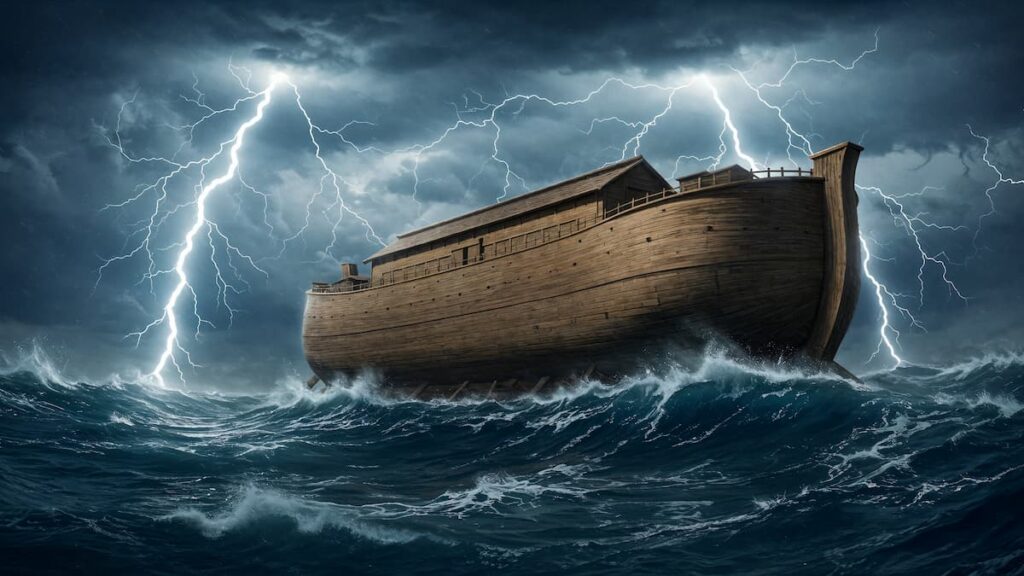
The size of Noah’s ark also suggests that the Flood was global rather than local. If the cubit is estimated at 17.5 inches, the ark was approximately 438 feet long, 72 feet wide, and 44 feet high. Because it had three decks, it had an area of about 95,700 square feet and a volume of 1,396,000 cubic feet.[^4] A vessel that big would not be necessary if the Flood had merely been local, and an ark would not even be necessary, for that matter. If the Flood were local, God could have just instructed Noah to leave the area, like He later told Lot to leave Sodom.
There is also another problem for people who believe in a local flood. In Genesis 9:11-17, God set the rainbow in the sky as a sign of His covenant to never again send another flood like the one he used to destroy the earth. He put the rainbow in the sky as a symbol of his promise. But there have been many local floods since then, and God would have broken his promise repeatedly if the Flood were local.
OT References
The Flood is not only mentioned in Genesis but also in other passages in the Old Testament, which talk about the Flood as though it were a real event. In Isaiah 54:9, God tells the people of Israel that he will not be angry with them and will not rebuke them again, as he promised to Noah that he would never send another worldwide flood. And in Ezekiel 14:14, God states that Noah, Daniel, and Job are examples of righteousness. In these two passages, God himself is speaking to the people of Israel and refers to Noah as a historical man.
NT References
There are also passages in the New Testament talking about the Flood as a real event. Jesus Christ even refers to Noah as a real person. In Matthew 24:37-39, Jesus compared the pre-diluvian world to the last day before the coming of the Son of Man. He taught that his return will be a surprise to the people of the world, just like the Flood was when it came and swept them all away. 1 and 2 Peter also talks about the Flood. 1 Peter 3:19-20 talks about how “the spirits in prison… did not obey” when God waited during Noah’s days, and how the ark saved eight people from death. As stated in the introduction, in 2 Peter 3:3-7, Peter talks about the time when men will not think about the Second Coming of Jesus as a universal interference by God into the world matters. This is because of their commitment to uniformitarianism, which is the doctrine that says that “all things are continuing as they were from the beginning of creation.” To answer these people, Peter addresses two past events that cannot be accounted for by uniformitarianism: creation and the Flood.[^5] Also, if the Flood were local, this means that the final destruction would only occur in part of the world.
Historical Evidence
In addition to biblical evidence, there is also much historical evidence that the Flood occurred. If the Flood really affected the entire human population, it would be reasonable to expect that memories of such a catastrophic event would remain in many cultural traditions. The accounts obviously would not be completely correct. There are “over 300” Flood legends recorded among cultures all around the world.[^6] Some Native American tribes have worldwide flood stories. One such story from the Choctaw tribe documents that men became so wicked that the Great Spirit destroyed the earth in a flood, and only one man lived.[^7]
Flood Legends
One of the most well-known flood stories is in the Epic of Gilgamesh, which was discovered on tablets in ancient Nineveh in 1832.[^8] In this story, the “Noah” is called Utnapishtim. Utnapishtim narrates how the god Ea revealed to him that humanity would be destroyed in a great flood. He built a ship shaped like a cube to save his family, craftsmen, and animals. The rain lasted for six days, and the ship landed on a mountain. He sent out a dove, a swallow, and a raven to see if the land was dry, then, when he came off the ark, he offered a sacrifice to the gods.[^9] There are many similarities between the accounts, but also differences. For example, the ark’s shape is different; Utnapishtim’s ark is shaped like a cube, which would roll in all directions with just a little force, and Noah’s ark is the perfect shape to weather a storm. These similarities suggest that the story may preserve a memory of the Flood, but it is clearly legendary, while the account in Genesis is written as history and recorded more accurately.
Interpretation in Church and Jewish History
Also, looking at Jewish and early church writings, one can see that they believed in a literal, global flood. Josephus, a Roman-Jewish historian, recounts the Flood as history in his book The Antiquities of the Jews. He says that when Noah was 600 years old, the Flood began. It rained for forty days until it “became fifteen cubits higher than the earth.” He also says that some of the ark still existed and that people took some of the bitumen to sell to other people.[^10]
Early Christian writers likewise considered the Flood as a literal account. Saint Augustine of Hippo, in his book The City of God, rejected the idea that the Flood was merely allegorical, but that it was true history. He also believes that the Bible describes a global flood. In his book, he spends some time answering objections about the Flood covering the mountains, the ability to build the ark, the ark’s size, and feeding carnivorous animals on the ark.[^11] Several other church fathers also believed in a global flood, including Justin Martyr, Theophilus, Tertullian, Gregory of Nazianzus, and Procopius of Gaza.[^12]
Geological Evidence
There is also geological evidence for a worldwide flood. The consensus nowadays is that rocks take millions of years to form. But scientifically, one can prove that it does not take millions of years for rock to form; for example, concrete can be formed in hours or days. A few examples of rapid rock formation are finding a clock, a ham, a cap, and a bag of flour in rocks around the world.[^13]
Rocks and rock layers
Rock layers do not take millions of years to form, as many modern geologists claim. Catastrophes, like volcanic eruptions, can rapidly create rock layers. The Mount St. Helens eruption in 1980 laid down rock layers in days, some extending more than 600 feet deep. If a small eruption caused this, a worldwide flood could produce even more extensive layers. One can also find bent or folded rock layers. There are many of these found in the Grand Canyon. These layers were still soft when they were put into this angle. Then they solidified into rock. Another piece of evidence is polystrate fossils. Trees, for example, have been found extending through various rock layers. Trees would decay before they could fossilize if it took millions or thousands of years to form the layers around them.[^14] Therefore, rock layers are not really evidence of millions of years.
Fossils
Millions of years are not required for fossils either. They have to form quickly or else the bones will decay. Fossils can even be formed in a lab. It requires rapid burial to remove the oxygen (so that it does not decay), then the water replaces the organic material with minerals. The conditions of the Flood were ideal for fossil formation. The Flood was not only a lot of water, but also a collection of dirt and mud. There are also many examples of rapid fossils, including an ichthyosaur giving birth while being buried, a fish in the middle of eating another fish, and turtles that were stuck while mating.[^15]
Other Indicators of Rapid Formation
There are many other items that are considered millions of years old, such as stalagmites, stalactites, gemstones, etcetera. Gemstones are often said to be millions of years old. Physics.org wrote: “The scientists show that diamonds take millions of years to grow. Moreover, diamonds are often half as old as the Earth.”[^16] However, some laboratories can make diamonds and other gemstones in days. Gemstones are also formed when a volcano erupts due to rapid heat and pressure. When Mount St. Helens erupted in 1980, many gemstones were produced.[^17]
When one enters a cave, the guides usually say that stalagmites and stalactites are millions of years old. However, they have been observed growing several inches within only a few days! In the early 1950s, someone left a bottle in a cave in Australia. The bottle is now coated with a layer of calcite and is already a “bottle stalagmite”.[^18] These things do not need millions of years to form, as many modern scientists say, but only days or years.
Conclusion
The evidence from the Bible, history, and geology supports that the Flood described in Genesis was a real global event. Scripture presents the Flood as a worldwide catastrophe that destroyed all life outside of the ark, and both Old and New Testament writers refer to Noah as a historical figure. Flood traditions found around the world suggest that humans have memories of a great catastrophic flood. Geological observations, such as bent rock layers, polystrate fossils, and rapid fossils, indicate that many natural features can be formed far more quickly than the millions of years often claimed by naturalists. Because the early chapters of Genesis provide the foundation for many biblical doctrines, their historical reliability has implications for the credibility of the entire Bible. Because Genesis forms an important foundation for the rest of the Bible, Christians should be prepared to defend the truth and reliability of its account.
Bibliography:
Augustine, Aurelius. The City of God, 426AD.
Flavius Josephus. The Works of Josephus: Complete and Unabridged. Translated by William Whiston. Peabody, Mass.: Hendrickson, 1987.
Garner, Paul. “The Church Fathers on the Genesis Flood.” Creation.com, February 28, 2012. https://creation.com/en/articles/church-fathers-flood
Ham, Ken, and Bodie Hodge. A Flood of Evidence: 40 Reasons Noah and the Ark Still Matter. Green Forest, Ar: Master Books, 2016.
Morris, Henry. The Genesis Record: A Scientific and Devotional Commentary on the Book of Beginnings. Grand Rapids, Michigan: Baker Book House, 1976.
Mortenson, Terry. “Noah’s Flood: A Historical, Global Catastrophe.” Answers in Genesis, October 10, 2020. https://answersingenesis.org/noahs-flood/
Osanai, Nozomi. “The Flood Accounts.” Creation.com, 2006. https://creation.com/articles/gilgamesh-epic-v-genesis-thesis-by-nozomi-osanai-chapter-2-the-flood-accounts
Physics.org. “Diamonds Grow like Trees, but over Millions of Years,” September 16, 2013. https://phys.org/news/2013-09-diamonds-trees-millions-years.html
The Holy Bible ESV: English Standard Version. Wheaton, Ill.: Crossway Bibles, 2001.
Walker, Tas. “The Genesis Flood and Noah’s Ark.” Creation.com, 2015. https://creation.com/en/articles/noahs-flood
Whitcomb, John C, and Henry M Morris. The Genesis Flood: The Biblical Record and Its Scientific Implications. Phillipsburg, N.J.: P & R Publishing, 1961.