

Editors Note: This article reflects the opinion of the writer, but should not be taken as Radi-Call’s official position. We recognize that this topic is controversial. However, we encourage our writers to give their honest opinions. Our desire is not to be controversial, but to begin discussions that encourage our readers to think about what they believe and why.
Amidst the swirl of springtime and daffodils and pandemic lockdowns, the Tuesday after the first Monday in November seems forgettably distant. It’s almost odd, how the election has fallen off the public radar. But the nonstop election coverage will come roaring back soon – don’t worry.
Pandemic aside, I’ve noticed a shift among Anabaptists when it comes to politics. We’ve become not only more aware of social issues, but also more vocal about political solutions. On social media, anyone can be a political pundit and (much to our chagrin) everyone seems to be a Social Justice Warrior or a Trump campaigner or an essential oil sales rep.
Historically, most Anabaptists have avoided the political realm. (The Münsterites did give theocracy a try, but it didn’t end well.) Generally, the Radical Reformation took root amid intense persecution that precluded any say in government. But that’s not true any longer. Today, we must figure out what it means to be separate from the world system in a country that offers and expects our participation. We must decide if our choice to stay out of politics has been convictional, or merely circumstantial.
Two boundary markers
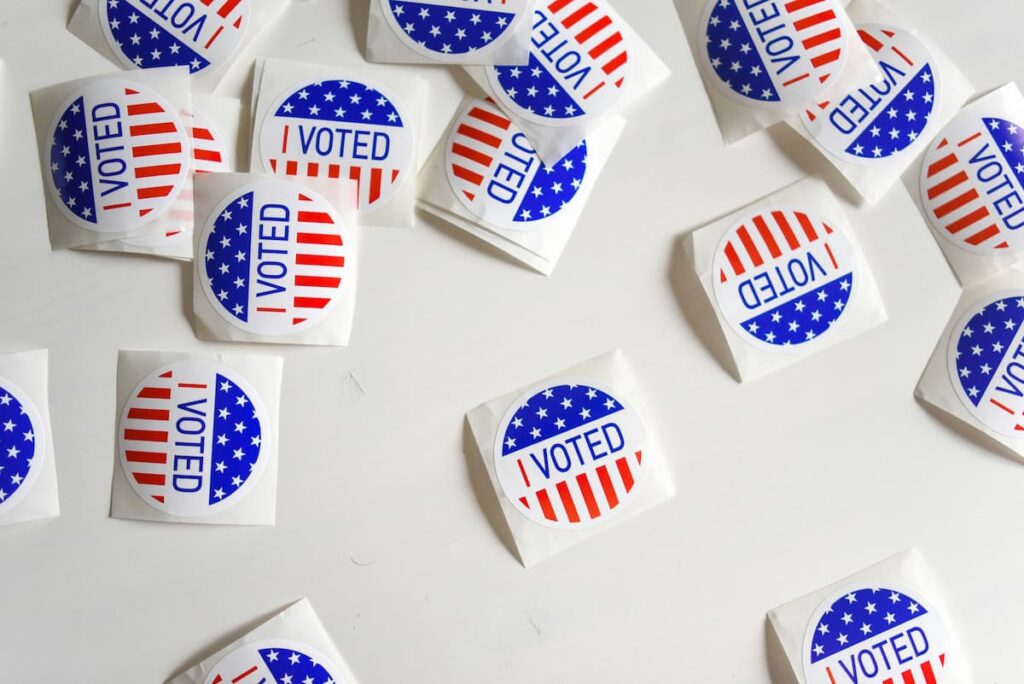
For the sake of brevity, I’ll limit my focus to voting. The question of voting is a practical one, and it relates to almost all other aspects of our political system.
Obviously, the Bible never addresses voting, but that doesn’t mean God’s Word offers no guidance. I find it helpful to consider two boundaries from Scripture to mark the edges of what is and is not appropriate:
1. The example of Paul shows that it’s appropriate to use our rights as citizens to further the gospel. (Acts 16:35-40; 22:25; 25:6-12) Notably, while Paul does invoke his rights to better share the gospel, and perhaps to avoid unnecessary punishment, he does not use them to get revenge for wrongful treatment.
2. The example of Jesus shows that, as citizens of an earthly country, we should respect and obey our rulers. However, we ultimately belong to another kingdom, which is not political and does not come about by force. (Matthew 22:21; John 18:33-38)
It’s important to realize that we face a unique political question, but a universal temptation. Do we vote to promote good? Perhaps there is room within Christian liberty for either conviction. If history is a guide, it’s not a choice we’ll face for long.
But does the kingdom of God come about by political maneuvering on our part? To that we must definitively, emphatically say no.
When it comes to voting, I don’t have a nicely packaged answer. I’ve heard well-thought-out arguments from both sides, but at the end of the day, I’m persuaded that voting is – at best – unwise and only moderately beneficial.
Here are five reasons not to vote
1. Choosing not to vote frees us from a compromising position of pragmatism where one must decide between competing moral interests. Many Christians point to abortion as the primary factor in their vote, but what about other issues of moral significance? With politicians, you get what you get. (Think “one-size-fits-all poncho”, not “well-tailored suit”).
2. Choosing not to vote frees us to speak truth that is not politically expedient. We’re free to admit that Donald Trump is not a man of character, yet respect him as our president anyway. Free to move beyond party talking points. Free to be Christians without (R)’s beside our names.
3. Choosing not to vote frees us from sticky moral conundrums. I find it helpful to consider two extreme scenarios: What if all politicians were Christians? And what if none were? Ask yourself, is it theoretically possible for the entire government to consist of Christian politicians promoting Christian values? Is that – should that – be our ideal? As a nonresistant Mennonite, I couldn’t in good conscience serve as Commander-in-Chief, but I’m hoping for a Baptist to come along instead? That’s inconsistent.
The second scenario is much more likely. At what point can the Christian no longer participate in good conscience in a secularized democratic society? Most democracies are rapidly secularizing to the point where no major party even claims to represent Christian values. (In Canada, for instance, no major party is willing to confront abortion.) When is the least-bad option no longer good enough?
4. Choosing not to vote frees us from picking sides in the political melodrama. No campaign seems complete without a healthy dose of self-promotion. Of course, it helps to lower the bar a bit by slandering political opponents. While there are outliers, this is the rule. This process does not reflect the words of Jesus that “whoever would be great among you must be your servant.”
5. Choosing not to vote frees us to share an untainted gospel. American Christianity hitched its wagon to American politics a long time ago. American Christians, pulled along by political expediency, have justified enslaving Africans, cheating Native Americans, murdering Filipinos, and bombing Laotians. Ironically, the American way melds church and state much the same as Constantine did with the Roman Empire: two strikingly different power structures, but both claiming the support and blessing of God. What damage does political involvement do to our Christian witness and the reputation of the gospel?
So should Christians do nothing?
That’s the wrong question. The right one is, “Should we add voting to the something we’re already doing?” The real problem with voting comes when we substitute it for doing something. We like to talk about ending abortion, and voting makes us feel that we’ve done our part. But real change – transformative, societal, lasting change – rarely happens in the voting booth.
What if we invested our time in the lives of the fatherless adolescents that live across the street? What if we had our Black and Hispanic neighbors over for a cookout? What if we volunteered at a local homeless shelter? These kinds of actions promote change in a fundamentally different way than political strategy. They promote life, dignity, and human flourishing in a holistic, unmeasurable way. They are inherently grassroots efforts, changing communities and individuals who in turn change society and culture. Good change happens organically, not forcefully, and it starts with us as Christians living the truth before a watching world.
This article was originally published on the Radi-Call blog at radi-call.com and is republished here with permission.