

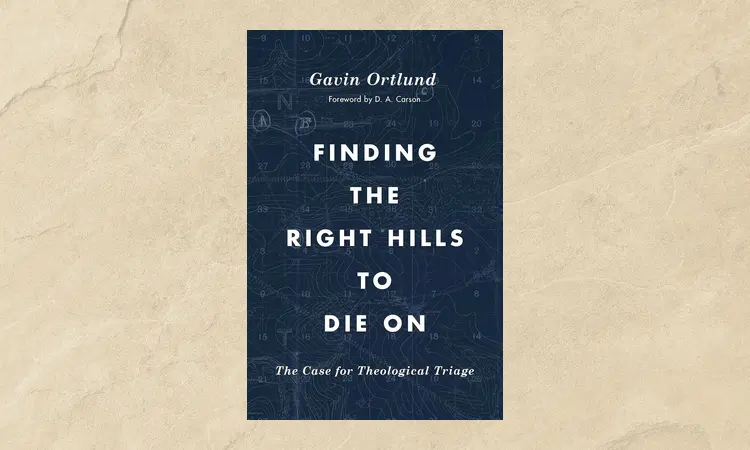
Paradoxically, Anabaptists have earned a reputation for both a strong emphasis on unity and a tendency toward schism. Perhaps this results from conflating unity with uniformity, which makes division the only option when disagreements inevitably arise. Of course, though we should never seek division, sometimes it’s necessary to protect the truth. So how do we decide when to divide and when to forbear? In Finding the Right Hills to Die on, Gavin Ortlund argues that theological triage can help us discern the path.
In medicine, triage involves ranking needs by relative importance. It’s a way to prioritize needs when time or resources are limited. Similarly, “theological triage is not primarily an intellectual exercise but a practical one” (77). Ortlund gives three categories to sort doctrinal disagreements. Primary doctrines are those essential to the gospel. We must not bend on primary issues because without them Christianity ceases to be Christian. Secondary doctrines are urgent for how the church functions (such as baptism or complementarianism). These doctrines often mark the boundaries of local church membership or ministry cooperation. Tertiary doctrines are issues important for right theology, but places where Christians can disagree without breaking fellowship.
Ortlund admits than any ranking system is imperfect. Instead of making a comprehensive list of which doctrines fit where, he spends most of his time arguing for why we need these distinctions at all. Almost all of us tend “to fight over doctrine too much or too little” (17). We should value Christian unity because Christ died for it—and not be so proud that we think we’re the only true Christians. At the same time, we must resist the temptation to say that none of the differences really matter. “If we isolate everything outside the gospel as a matter of indifference, we end up trivializing the majority of what God has communicated to us” (50).
When it comes to specific doctrines—and even how we rank them—I don’t agree with all of Ortlund’s positions, especially his acceptance of old earth creation and his choice to rank it as a tertiary issue. (Surely a disagreement that touches on the creation of humanity, the origin of sin, and inerrancy in relation to scientific consensus deserves significant concern). Of course, this tests the thesis of the book. Can we still learn from Ortlund and recognize him as a fellow Christian in spite of his shortcomings? In this case, I think yes. That said, determining the bounds of fellowship proves just as challenging as ranking doctrines. We might read someone’s book, but not ask them to teach at our Bible Institute; we might accept a person as a member, but not ordain them as a pastor; or we might work with another church to do disaster relief, but not to start a joint bible study. Though he doesn’t address specific scenarios, Ortlund acknowledges this complexity, encouraging both honesty and humility.
Finding the Right Hills to Die on calls us to see ourselves as members of Christ’s universal church. That doesn’t mean we should settle for a shallow ecumenicalism. Instead, we need wisdom to recognize that specifics matter, but also seek to see the best in Christians who disagree with us.